30-day mandolin practice plan
A month of short daily sessions for a new mandolin: the easiest chords on its tuning, in G, C and Bb, the changes between them, two strums, the metronome, and a song in the player. Each day’s link opens the tool with the settings already filled in.
Tune the mandolin first · 30-day mandolin practice calendar (PDF)
Left-handed? every diagram drawn for the left hand, with the thickest string on the right.
A day is one short session; do it, tick it off, and come back tomorrow. If a day is hard, do it again before moving on — the plan waits for you. Your ticks stay in this browser.
Week 1 · First chords
Tune the mandolin
Tune every string with the tuner, then play each one open and listen. Start every day like this from now on.
Learn G and C
Open each chord’s page, put your fingers on the first shape, and play the strings one at a time until each one rings.
Change between G and C
Change from one shape to the other and back, slowly, without strumming at first; then four beats on each.
Learn D7
Open each chord’s page, put your fingers on the first shape, and play the strings one at a time until each one rings.
Change between C and D7
Change from one shape to the other and back, slowly, without strumming at first; then four beats on each.
Strum: Pop / ballad
Play along with the pattern on its page at the slowest tempo, over the chords it shows; the step lit up is the one sounding.
Chord quiz: G, C and D7
Ten questions: a diagram, four names. Get them right, then do another round.
Week 2 · The whole key, in time
Learn Em
Open each chord’s page, put your fingers on the first shape, and play the strings one at a time until each one rings.
Change between D7 and Em
Change from one shape to the other and back, slowly, without strumming at first; then four beats on each.
I–IV–V7 in G
Hear the sequence on its page, then play it along: one chord per bar, round and round.
Pop / ballad at 60 BPM
Count the levada with the metronome, then strum it on one chord you know, in time with the click.
Notes on the 3rd and 4th strings
Find the natural notes from the open strings to the 5th fret, then name them; the drill keeps score.
I–VIm–IV–V in G
Hear the sequence on its page, then play it along: one chord per bar, round and round.
Play the demo song
Open it in the player with the auto-scroll: the chord you are on and the next one stay in view beside the lyrics.
Week 3 · A second key and a second strum
The chords of C
The chords that belong together in this key. You know some of them already; play the rest once each.
Learn G7, Am and F
Open each chord’s page, put your fingers on the first shape, and play the strings one at a time until each one rings.
Change between C and Am
Change from one shape to the other and back, slowly, without strumming at first; then four beats on each.
Strum: Marchinha (carnival march)
Play along with the pattern on its page at the slowest tempo, over the chords it shows; the step lit up is the one sounding.
Chord quiz: G, C, D7, Em, G7, Am and F
Ten questions: a diagram, four names. Get them right, then do another round.
The G scale
Play the scale slowly, up from the tonic and back down, saying the note names.
I–V–VIm–IV in C
Hear the sequence on its page, then play it along: one chord per bar, round and round.
Week 4 · A third key, the capo and a song of your own
Learn Gm, F7, Bb and Eb
Open each chord’s page, put your fingers on the first shape, and play the strings one at a time until each one rings.
Notes on the 1st and 2nd strings
Find the natural notes from the open strings to the 5th fret, then name them; the drill keeps score.
Strum: Samba
Play along with the pattern on its page at the slowest tempo, over the chords it shows; the step lit up is the one sounding.
Marchinha (carnival march) at 100 BPM
Count the levada with the metronome, then strum it on one chord you know, in time with the click.
Capo on the 2nd fret
With the capo on fret 2, the G shapes you know sound in A. The page has every other choice.
I–VIm–IIm–V7 in Bb
Hear the sequence on its page, then play it along: one chord per bar, round and round.
Chord quiz: every beginner chord
Ten questions: a diagram, four names. Get them right, then do another round.
The demo song again
Play it all the way through with the auto-scroll a little faster than last time.
A song of your own
Bring in a song you love — paste its chords, or send it from Cifra Club — and play it in the player.
Printable calendar — a gift to go with the instrument
One A4 page: the thirty days to tick off, with a line for who it is for and who it is from. Fold it into a card with the instrument.
30-day mandolin practice calendar (PDF) — 195 kB · 30
Share this plan
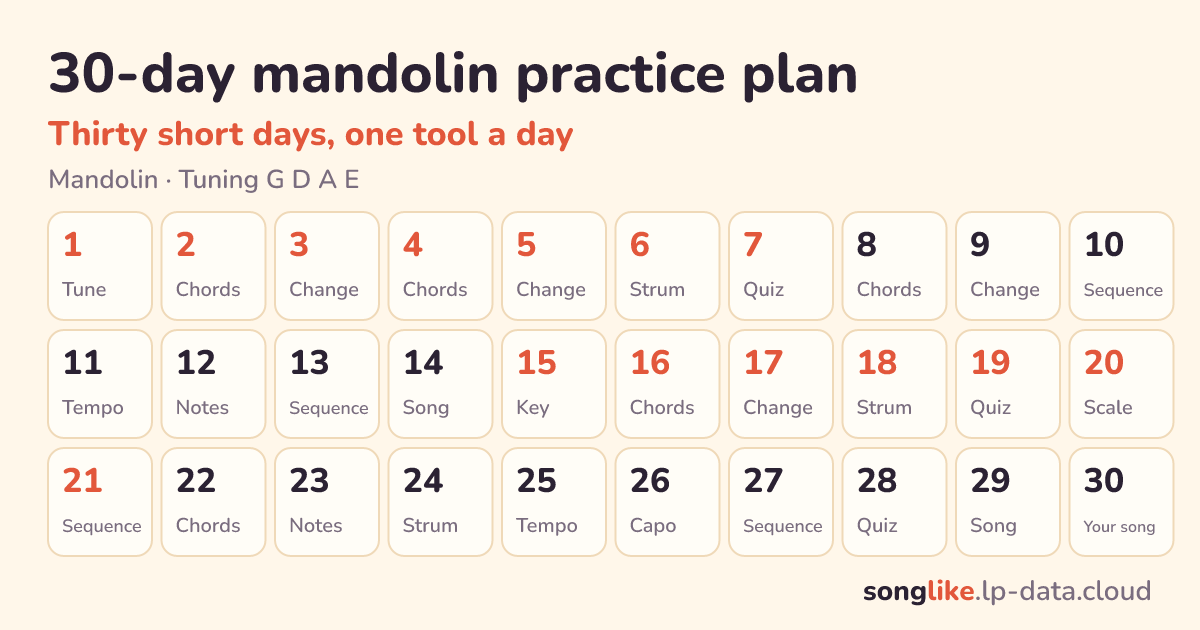
Free to use on your site, blog or class handout, with a link to this page. Copy this code:
<a href="https://songlike.lp-data.cloud/practice-plan/mandolin"><img src="https://songlike.lp-data.cloud/img/practice-plan/mandolin.png" alt="A 30-day mandolin practice plan, day by day" width="600" height="315"></a>Beginner chords · Mandolin — New to this instrument? Start with these chords.
Tired of looking chords up mid-song? Bring the sheet into songlike and the diagram for the chord you are on — and the next one — stays beside the lyrics.
Got the whole sheet? See every chord in it.
Need the song in another key? Transpose the sheet.
Found a shape and don't know its name? Tap it in.
Chord diagram quiz — see a shape, name the chord — ten questions on your instrument, no account.